Läuft auf Ihrem Rechner · handelt nur auf Ihr Wort
Die Steuerungsebene
für KI-Agenten
- Jeden Agenten sehen.
- Jede Aktion verstehen.
- Stoppen, was nicht passieren soll.
ClawMetry liest die 26 Agent-Runtimes, die Ihr Team ohnehin betreibt, von Claude Code und Cursor bis Codex und OpenClaw, direkt aus den Dateien, die sie ohnehin schreiben. Am Agenten selbst ist nichts zu ergänzen.
$ pip install clawmetry && clawmetry
7 Tage, alle Runtimes, ohne Karte. Danach $9 oder $19 pro Node und Monat.
“claude_code: 84 tool calls, no file changes, not advancing.” Stop or Pause this agent from the ClawMetry dashboard or device.
Verbatim record, not a mockup. A real detection from the laptop ClawMetry was built on. The steps, the counts and the message are what the daemon wrote to disk.
❯ Supported agent runtimes
Don't see the agent harness you use?
Just share it and we'll add support in ~2 days. Leave your email and we'll ping you the moment it's live, plus 2 months of Pro, on us.
We only use your email to notify you and issue the Pro credit. No lists, no spam.
Gemessen, eine Installation, vier Monate
Markiert werden Agenten, die feststecken,
nicht Agenten, die Geld kosten.
Eine lange, teure Session ist oft Ihre beste Arbeit, deshalb würde ein Tool, das auf große Zahlen zielt, das Falsche abwürgen. ClawMetry schaut darauf, ob ein Agent überhaupt etwas produziert. Gleicher Laptop, vier Monate, beide Fälle nebeneinander.
Arbeitet · nie markiert
$171.58
The most expensive session of the four months. It ran long and cost real money, and it was writing code the whole time. ClawMetry left it alone, which is the correct answer.
Markiert · steckt fest
$175.10
Every one caught for the same reason: tool calls with no file changes, the same failure repeating, or a loop that stopped advancing. Most of them cost less than the session on the left.
Detektoren warnen. Sie handeln nicht. Alle sieben dieser Sessions liefen bis zum Ende durch. Die Markierung ist eine Benachrichtigung, kein Auslöser. Nichts wird gestoppt, außer ein Mensch stoppt es oder Sie setzen selbst ein Ausgabenlimit und ein Agent überschreitet es.
165 sessions and $826.47 of agent spend on one developer’s laptop, April to August 2026. One machine, not a customer aggregate. Yours will look different, which is the reason to read your own.
Sehen Sie es in Aktion
Ein Bildschirm. Alles, was bei Ihren Agenten passiert.
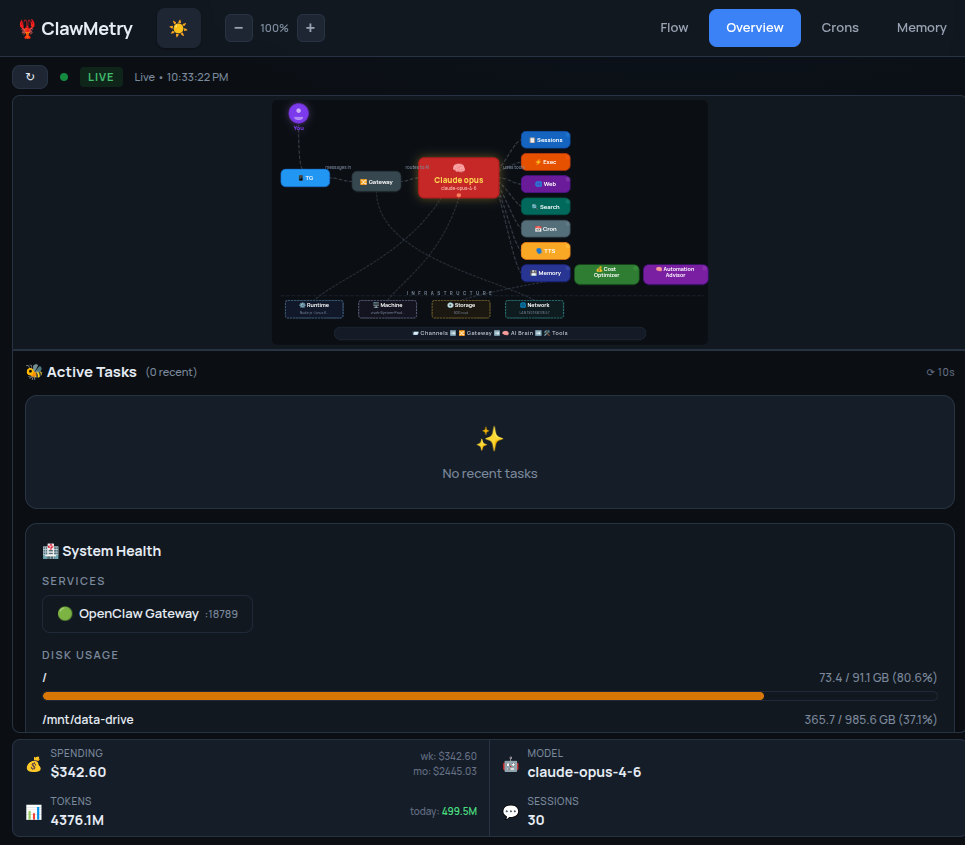
Die Lücken stehen in der Tabelle
Was wir können, pro Runtime.
Jeder Anbieter in dieser Kategorie spricht von Guardrails. Hier ist die vollständige Matrix, samt der leeren Felder.
| Runtime | Beobachten | Vor Ausführung blockieren | Im Lauf beenden | Kosten in Dollar |
|---|---|---|---|---|
| OpenClaw, NVIDIA NemoClaw, Goosefree forever | ✓ | via proxy | ✓ | ✓ |
| Claude Codethe only pre-execution tool gate | ✓ | ✓ | ✓ | ✓ |
| Codex, OpenCode, Aider | ✓ | via proxy | ✓ | ✓ |
| Cursorone IDE process holds every session | ✓ | – | – | – |
| GitHub Copilotbilled in vendor credits, not USD | ✓ | – | – | – |
| NanoClaw, PicoClaw, Kimi CLIno model id on disk | ✓ | – | – | – |
| Qwen, Hermes, Pi, Deep Agents, n8n, Antigravity, Grok, QM, DeepSeek Harness, Exo |
✓ | via proxy | – | ✓ |
Vor Ausführung blockieren
Claude Code gets a real pre-execution gate: a PreToolUse hook parks the call before the tool fires. Everything routed through the ClawMetry proxy gets spend refused with a 429 before tokens are spent.
Im Lauf beenden
A gateway kill for OpenClaw, and SIGSTOP then SIGKILL against the process tree for the CLI runtimes, with a guard so a recycled pid is never the one we hit. macOS and Linux. Windows has no SIGSTOP, so pause and resume do not exist there.
Nachträglich prüfen
Every event carries a SHA-256 chain over its immutable fields, per node, with a verifier command. Approval decisions land in an append-only log. Works on every runtime.
Bevor Sie einen Daemon auf Ihren Laptop lassen
Was es mit dem Rechner macht
und was ihn verlässt.
Auf demselben Laptop gemessen, nicht geschätzt.
Footprint
clawmetry uninstallThe query server binds to loopback only, with a one-time 32-hex token and a discovery file at mode 0600. It is why the dashboard can read the store without holding the writer lock.
Was genau den Rechner verlässt
Never. These stay in the local file.
The key is generated on the node and never leaves it. Decryption happens in your browser. Compelled by a subpoena, we hand over a blob we cannot open, plus the node id, the version and some counters.
Die lokale Datei liegt im Klartext vor
Everything is sealed in transit and at rest in our cloud, and it is not encrypted on your own disk. The DuckDB file carries default user permissions. Anything running as your user can read it.
Die Schwärzung greift im Fehlerfall nicht
Secrets are fingerprinted at ingest by default, before disk. It is pattern-based, and on an internal error it keeps the original value rather than dropping data. It is tuned for credential shapes, not customer PII.
Ein verbundener Node lässt sich aus der Ferne stoppen
If you turn cloud on, Stop, Pause and Resume are reachable from the dashboard and the desk device for any node on the account. That is the feature. Run local-only and no such channel exists.
Starred by the people building AI
Engineers and founders from OpenAI, Google, PostHog and more have starred ClawMetry on GitHub. One of them helped build it.















Drei Orte für den Betrieb
Cloud ist optional.
Das war sie schon immer.
Der Daemon rechnet in eine DuckDB-Datei auf Ihrer eigenen Festplatte. Wo das Dashboard danach liegt, entscheiden Sie, und der Preis ist in jedem Fall derselbe.
01 · Local only
Nichts verlässt den Rechner
Included in the MIT core
The dashboard reads the local file through a loopback query server. There is no account, no sync and no destination to point at.
- Network destinations: none
- Inbound ports opened: 0
- Free forever for OpenClaw, NVIDIA NemoClaw and Goose
02 · Our cloud
Versiegelt, bevor es geht
$19 per node, per month
The snapshot is encrypted on the node with a key generated there and never sent. Your browser decrypts it. Subpoena us and we hand over a blob we cannot open.
- AES-256-GCM, key held on the node
- Decryption happens client side
- Stop, Pause and Resume reach any node on the account
03 · Self-hosted
Ihre Infrastruktur, Single Tenant
$190 per node, per year
One container serves the UI and the ingest API on your own network, with node tokens and admin auth. Licences verify offline against an embedded Ed25519 key you can fingerprint and compare.
- No calls to clawmetry.com beyond an off-by-default version ping
- Same feature set, same runtimes, same rate
- Two months free against the monthly price
Der Preis ändert sich nicht mit dem Deployment. Self-Hosted kostet $19 pro Node und Monat oder $190 pro Node und Jahr, genau wie der Cloud-Plan, denn Sie zahlen für die Software und nicht für unsere Server. Anders ist nur, wer die Daten hält und wer den Container betreibt. Self-Hosted-Key kaufen, ganz ohne Gespräch.
Ein Preis, ein Zähler
Rechnen Sie Ihre Zahl aus,
bevor Sie mit jemandem sprechen.
7 days, every runtime, no card
$19per node, per month
Pro, billed monthly. Starter is $9 and covers fewer features, not fewer runtimes. Annual is $190 per node, two months free. Free forever for OpenClaw, NVIDIA NemoClaw and Goose.
Start the trial- Every runtime, including Claude Code, Codex and Cursor.
- Cloud or fully self-hosted, at the same rate. Unlimited chat channels.
- Waste flags, error triage, cost optimizer, OTLP export, tool policy.
- Cancel any time in Stripe. No contract, no seat count.
Already decided? Buy now and install after. Your key is on the next screen.
Was es Sie kostet
Zählen Sie die Maschinen, auf denen der Daemon läuft, nicht die Menschen, die draufschauen.
$551 $6,612 per year · 29 nodes
A node is a machine running the daemon and reporting a heartbeat. The unit of attribution is a machine, so spend maps to a laptop, not to a team. The same number applies self-hosted, so you can price a deployment on your own infrastructure off this figure without asking us. Ephemeral CI runners are not yet specified; the fleet brief carries the rule in writing before you sign.
Für alle, die das Risiko tragen
Der Betrieb im ganzen Unternehmen.
Ihre Entwickler haben im letzten Quartal Claude Code, Cursor, Codex und Copilot installiert. Beschafft hat sie niemand, und alle haben Zugriff auf Ihr Repo und Ihre Keys.
Nichts, was in den Agenten installiert werden muss
Each runtime is read from the session store it already writes. No SDK, no wrapper, no second agent on the laptop, nothing a developer has to opt into or can forget.
A control layer that governs only its own SDK is blind to everything a developer runs outside it.Self-Hosting ist die Antwort auf SSO
SSO does not exist yet. Single-tenant self-hosted does: one container serves the UI and the ingest API, with node tokens and admin auth, and licences verify offline against an embedded Ed25519 key you can fingerprint and compare.
A self-hosted deployment makes no calls to clawmetry.com beyond an off-by-default version ping.Passt in Ihr bestehendes Netzwerk
SIEM and syslog export in CEF or JSON over TCP, UDP or TLS, emitted daemon-side because the cloud never holds plaintext. Corporate TLS interception is supported, with a doctor command that walks DNS, TCP, proxy and TLS in order.
In: your collector feeds us over OTLP. Out: full-event SIEM export. Not yet: correlated spans carrying your trace ids.Flotten-Rollout erfolgt derzeit manuell
There is no Helm chart, no Terraform provider and no Intune or Jamf package. If a daemon on developer laptops is a non-starter, run the enforcement proxy centrally and govern spend without touching an endpoint.
Auto-update ships on by default. CLAWMETRY_AUTO_UPDATE=0 turns it off. No staged rollout, no version pinning.Fragen, die uns jedes Mal gestellt werden.
Können Sie etwas blockieren, bevor es läuft, oder mir nur sagen, dass es gelaufen ist?
Both, and the split is in the table above. Claude Code gets a genuine pre-execution tool gate, and anything routed through the proxy gets spend refused with a 429 before tokens are spent. For the other runtimes it is detection plus process control: we can see it and end it, we cannot veto the call it already made.
Is ClawMetry only for OpenClaw?
No. It launched in February 2026 as an OpenClaw-only dashboard and many directory listings still describe it that way, but it now reads 26 runtimes: OpenClaw, Claude Code, Cursor, GitHub Copilot, Codex, Gemini CLI, Cline, OpenHands, OpenCode, NVIDIA NemoClaw, Aider, Goose, n8n, Qwen, Devin, Antigravity, Grok, Hermes, Pi, Deep Agents, Kimi CLI, DeepSeek Harness, Exo, NanoClaw, PicoClaw and QM. It auto-detects whichever of those are on the machine, so a mixed fleet lands in one dashboard. OpenClaw, NVIDIA NemoClaw and Goose are free forever in the open source package; the rest are on the paid tier.
Stoppt es meine Agenten von selbst?
No. Detectors write a warning and stop there. On the reference install every flagged session ran to completion. A run ends only when a person ends it, or when you have set a spend cap yourself and an agent crosses it.
Verändert es die Ausführung meiner Agenten?
Read-only by default. Two things you opt into change that: the proxy, a separate process you point one env var at, and approval gates, where ClawMetry adds a gate to the runtime’s own permission system and removes only what it added.
Was passiert, wenn meine Testphase endet?
The paid runtimes stop being read and the free three keep working. Entitlements are a commercial boundary, not a technical one. We do not hard-block a running fleet on a licence check.
Wer steckt dahinter, und was passiert, wenn Sie verschwinden?
One person, plus contributors. The core is MIT and runs on your machine, so if we vanish your install keeps working and your data stays in a DuckDB file you own. The paid layer is a separate closed package. Ask for the fleet brief and it names the legal entity, the largest deployment we run today, and the reference count, with no rounding.
Besteht das eine Sicherheitsprüfung?
For a pilot on non-production machines, usually: MIT source you can audit, local-first storage, single-tenant self-hosted and offline licence verification are the arguments that work. For a regulated production rollout, read the gap list first. SSO, RBAC beyond owner and member, SOC 2, CAIQ and a third-party pen test are all absent, and that is a two-to-four quarter conversation.