Fonctionne sur votre machine · n'agit que sur votre ordre
Le plan de contrôle
des agents IA
- Voyez chaque agent.
- Comprenez chaque action.
- Arrêtez ce qui ne devrait pas arriver.
ClawMetry lit les 26 runtimes d'agents que votre équipe utilise déjà, de Claude Code et Cursor à Codex et OpenClaw, directement dans les fichiers qu'ils écrivent. Rien à ajouter à l'agent.
$ pip install clawmetry && clawmetry
7 jours, tous les runtimes, sans carte bancaire. Ensuite 9 $ ou 19 $ par nœud et par mois.
“claude_code: 84 tool calls, no file changes, not advancing.” Stop or Pause this agent from the ClawMetry dashboard or device.
Verbatim record, not a mockup. A real detection from the laptop ClawMetry was built on. The steps, the counts and the message are what the daemon wrote to disk.
❯ Supported agent runtimes
Don't see the agent harness you use?
Just share it and we'll add support in ~2 days. Leave your email and we'll ping you the moment it's live, plus 2 months of Pro, on us.
We only use your email to notify you and issue the Pro credit. No lists, no spam.
Mesuré, une installation, quatre mois
Il signale les agents qui s'enlisent,
pas ceux qui coûtent cher.
Une session longue et coûteuse correspond souvent à votre meilleur travail : un outil qui traque les gros chiffres éliminerait donc la mauvaise cible. ClawMetry regarde si un agent produit quelque chose. Même ordinateur, quatre mois, les deux cas côte à côte.
En marche · jamais signalé
$171.58
The most expensive session of the four months. It ran long and cost real money, and it was writing code the whole time. ClawMetry left it alone, which is the correct answer.
Signalé · enlisé
$175.10
Every one caught for the same reason: tool calls with no file changes, the same failure repeating, or a loop that stopped advancing. Most of them cost less than the session on the left.
Les détecteurs alertent. Ils n'agissent pas. Ces sept sessions sont toutes allées à leur terme. Le signalement est une notification, pas un déclencheur. Rien n'est arrêté sans qu'une personne l'arrête, ou sans que vous ayez vous-même fixé un plafond de dépenses qu'un agent dépasse.
165 sessions and $826.47 of agent spend on one developer’s laptop, April to August 2026. One machine, not a customer aggregate. Yours will look different, which is the reason to read your own.
Voyez-le en action
Un seul écran. Tout ce qui se passe sur vos agents.
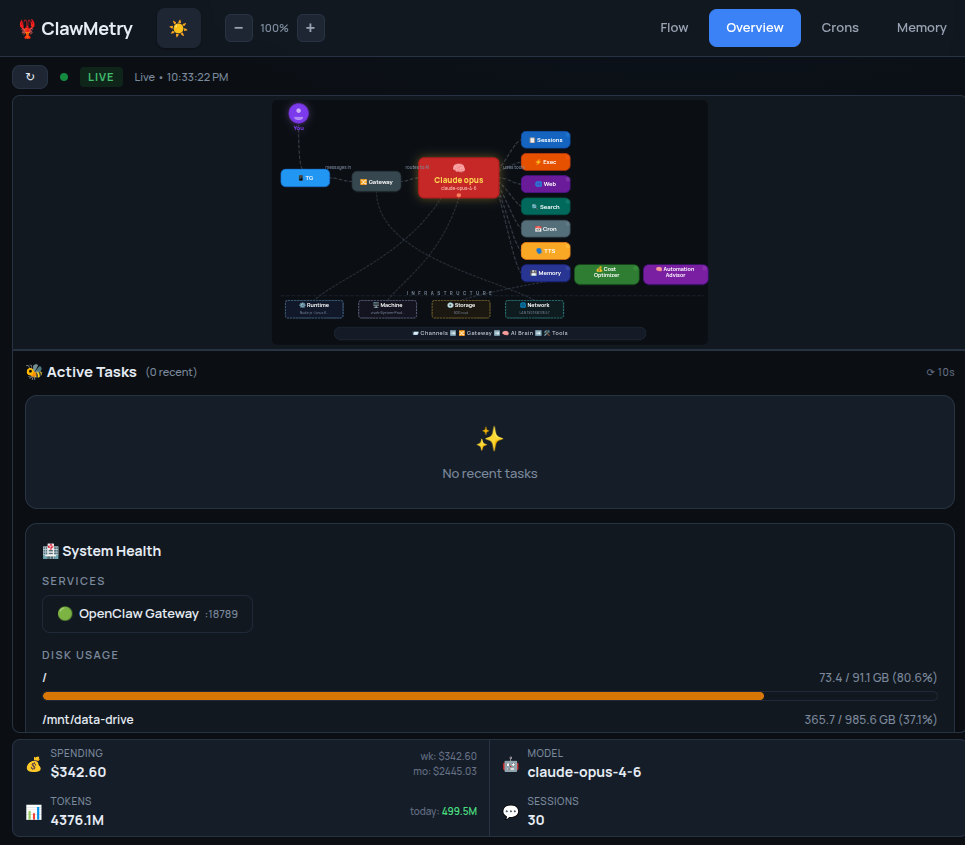
Les lacunes sont dans le tableau
Ce que nous pouvons faire, runtime par runtime.
Tous les acteurs de cette catégorie promettent des garde-fous. Voici la matrice complète, cases vides comprises.
| Runtime | Observer | Bloquer avant exécution | Interrompre en cours | Coût en dollars |
|---|---|---|---|---|
| OpenClaw, NVIDIA NemoClaw, Goosefree forever | ✓ | via proxy | ✓ | ✓ |
| Claude Codethe only pre-execution tool gate | ✓ | ✓ | ✓ | ✓ |
| Codex, OpenCode, Aider | ✓ | via proxy | ✓ | ✓ |
| Cursorone IDE process holds every session | ✓ | – | – | – |
| GitHub Copilotbilled in vendor credits, not USD | ✓ | – | – | – |
| NanoClaw, PicoClaw, Kimi CLIno model id on disk | ✓ | – | – | – |
| Qwen, Hermes, Pi, Deep Agents, n8n, Antigravity, Grok, QM, DeepSeek Harness, Exo |
✓ | via proxy | – | ✓ |
Bloquer avant exécution
Claude Code gets a real pre-execution gate: a PreToolUse hook parks the call before the tool fires. Everything routed through the ClawMetry proxy gets spend refused with a 429 before tokens are spent.
Interrompre en cours
A gateway kill for OpenClaw, and SIGSTOP then SIGKILL against the process tree for the CLI runtimes, with a guard so a recycled pid is never the one we hit. macOS and Linux. Windows has no SIGSTOP, so pause and resume do not exist there.
Auditer après coup
Every event carries a SHA-256 chain over its immutable fields, per node, with a verifier command. Approval decisions land in an append-only log. Works on every runtime.
Avant d'installer un démon sur votre portable
Ce qu'il fait à la machine,
et ce qui en sort.
Mesuré sur ce même portable, pas estimé.
Empreinte
clawmetry uninstallThe query server binds to loopback only, with a one-time 32-hex token and a discovery file at mode 0600. It is why the dashboard can read the store without holding the writer lock.
Ce qui sort, exactement
Never. These stay in the local file.
The key is generated on the node and never leaves it. Decryption happens in your browser. Compelled by a subpoena, we hand over a blob we cannot open, plus the node id, the version and some counters.
Le fichier local est en clair
Everything is sealed in transit and at rest in our cloud, and it is not encrypted on your own disk. The DuckDB file carries default user permissions. Anything running as your user can read it.
L'expurgation échoue en mode ouvert
Secrets are fingerprinted at ingest by default, before disk. It is pattern-based, and on an internal error it keeps the original value rather than dropping data. It is tuned for credential shapes, not customer PII.
Un nœud connecté peut être arrêté à distance
If you turn cloud on, Stop, Pause and Resume are reachable from the dashboard and the desk device for any node on the account. That is the feature. Run local-only and no such channel exists.
Starred by the people building AI
Engineers and founders from OpenAI, Google, PostHog and more have starred ClawMetry on GitHub. One of them helped build it.














Trois façons de le déployer
Le cloud est optionnel.
Il l'a toujours été.
Le démon calcule dans un fichier DuckDB sur votre propre disque. Où vit le tableau de bord ensuite, c'est votre choix, et le tarif reste le même quelle que soit l'option.
01 · Local only
Rien ne sort
Included in the MIT core
The dashboard reads the local file through a loopback query server. There is no account, no sync and no destination to point at.
- Network destinations: none
- Inbound ports opened: 0
- Free forever for OpenClaw, NVIDIA NemoClaw and Goose
02 · Our cloud
Scellé avant de sortir
$19 per node, per month
The snapshot is encrypted on the node with a key generated there and never sent. Your browser decrypts it. Subpoena us and we hand over a blob we cannot open.
- AES-256-GCM, key held on the node
- Decryption happens client side
- Stop, Pause and Resume reach any node on the account
03 · Self-hosted
Votre infrastructure, mono-tenant
$190 per node, per year
One container serves the UI and the ingest API on your own network, with node tokens and admin auth. Licences verify offline against an embedded Ed25519 key you can fingerprint and compare.
- No calls to clawmetry.com beyond an off-by-default version ping
- Same feature set, same runtimes, same rate
- Two months free against the monthly price
Le tarif ne change pas selon le déploiement. L'auto-hébergement coûte 19 $ par nœud et par mois ou 190 $ par nœud et par an, exactement comme l'offre cloud, parce que vous payez le logiciel et non nos serveurs. Ce qui change, c'est qui détient les données et qui exploite le conteneur. Achetez une clé auto-hébergée sans parler à personne.
Un tarif, un compteur
Calculez votre montant
avant de parler à qui que ce soit.
7 days, every runtime, no card
$19per node, per month
Pro, billed monthly. Starter is $9 and covers fewer features, not fewer runtimes. Annual is $190 per node, two months free. Free forever for OpenClaw, NVIDIA NemoClaw and Goose.
Start the trial- Every runtime, including Claude Code, Codex and Cursor.
- Cloud or fully self-hosted, at the same rate. Unlimited chat channels.
- Waste flags, error triage, cost optimizer, OTLP export, tool policy.
- Cancel any time in Stripe. No contract, no seat count.
Already decided? Buy now and install after. Your key is on the next screen.
Ce que cela vous coûte
Comptez les machines qui feront tourner le démon, pas les personnes qui consulteront le tableau de bord.
$551 $6,612 per year · 29 nodes
A node is a machine running the daemon and reporting a heartbeat. The unit of attribution is a machine, so spend maps to a laptop, not to a team. The same number applies self-hosted, so you can price a deployment on your own infrastructure off this figure without asking us. Ephemeral CI runners are not yet specified; the fleet brief carries the rule in writing before you sign.
Pour ceux qui portent le risque
Déployer à l'échelle de l'entreprise.
Vos ingénieurs ont installé Claude Code, Cursor, Codex et Copilot le trimestre dernier. Personne ne les a achetés, et tous ont accès à votre dépôt et à vos clés.
Rien à installer dans l'agent
Each runtime is read from the session store it already writes. No SDK, no wrapper, no second agent on the laptop, nothing a developer has to opt into or can forget.
A control layer that governs only its own SDK is blind to everything a developer runs outside it.L'auto-hébergement est la réponse au SSO
SSO does not exist yet. Single-tenant self-hosted does: one container serves the UI and the ingest API, with node tokens and admin auth, and licences verify offline against an embedded Ed25519 key you can fingerprint and compare.
A self-hosted deployment makes no calls to clawmetry.com beyond an off-by-default version ping.Compatible avec le réseau dont vous disposez
SIEM and syslog export in CEF or JSON over TCP, UDP or TLS, emitted daemon-side because the cloud never holds plaintext. Corporate TLS interception is supported, with a doctor command that walks DNS, TCP, proxy and TLS in order.
In: your collector feeds us over OTLP. Out: full-event SIEM export. Not yet: correlated spans carrying your trace ids.Le déploiement de flotte est manuel aujourd'hui
There is no Helm chart, no Terraform provider and no Intune or Jamf package. If a daemon on developer laptops is a non-starter, run the enforcement proxy centrally and govern spend without touching an endpoint.
Auto-update ships on by default. CLAWMETRY_AUTO_UPDATE=0 turns it off. No staged rollout, no version pinning.Les questions qu'on nous pose à chaque fois.
Pouvez-vous bloquer une action avant son exécution, ou seulement me dire qu'elle a eu lieu ?
Both, and the split is in the table above. Claude Code gets a genuine pre-execution tool gate, and anything routed through the proxy gets spend refused with a 429 before tokens are spent. For the other runtimes it is detection plus process control: we can see it and end it, we cannot veto the call it already made.
Is ClawMetry only for OpenClaw?
No. It launched in February 2026 as an OpenClaw-only dashboard and many directory listings still describe it that way, but it now reads 26 runtimes: OpenClaw, Claude Code, Cursor, GitHub Copilot, Codex, Gemini CLI, Cline, OpenHands, OpenCode, NVIDIA NemoClaw, Aider, Goose, n8n, Qwen, Devin, Antigravity, Grok, Hermes, Pi, Deep Agents, Kimi CLI, DeepSeek Harness, Exo, NanoClaw, PicoClaw and QM. It auto-detects whichever of those are on the machine, so a mixed fleet lands in one dashboard. OpenClaw, NVIDIA NemoClaw and Goose are free forever in the open source package; the rest are on the paid tier.
Est-ce que ça va arrêter mes agents de sa propre initiative ?
No. Detectors write a warning and stop there. On the reference install every flagged session ran to completion. A run ends only when a person ends it, or when you have set a spend cap yourself and an agent crosses it.
Est-ce que ça modifie le fonctionnement de mes agents ?
Read-only by default. Two things you opt into change that: the proxy, a separate process you point one env var at, and approval gates, where ClawMetry adds a gate to the runtime’s own permission system and removes only what it added.
Que se passe-t-il à la fin de mon essai ?
The paid runtimes stop being read and the free three keep working. Entitlements are a commercial boundary, not a technical one. We do not hard-block a running fleet on a licence check.
Qui est derrière le projet, et que se passe-t-il si vous disparaissez ?
One person, plus contributors. The core is MIT and runs on your machine, so if we vanish your install keeps working and your data stays in a DuckDB file you own. The paid layer is a separate closed package. Ask for the fleet brief and it names the legal entity, the largest deployment we run today, and the reference count, with no rounding.
Est-ce que ça passera une revue de sécurité ?
For a pilot on non-production machines, usually: MIT source you can audit, local-first storage, single-tenant self-hosted and offline licence verification are the arguments that work. For a regulated production rollout, read the gap list first. SSO, RBAC beyond owner and member, SOC 2, CAIQ and a third-party pen test are all absent, and that is a two-to-four quarter conversation.