Gira sulla tua macchina · agisce solo quando lo decidi tu
Il control plane
per gli agenti AI
- Vedi ogni agente.
- Capisci ogni azione.
- Fermi ciò che non deve accadere.
ClawMetry legge i 26 runtime per agenti che il tuo team già usa, da Claude Code e Cursor a Codex e OpenClaw, direttamente dai file che scrivono. Nulla da aggiungere all'agente.
$ pip install clawmetry && clawmetry
7 giorni, tutti i runtime, senza carta. Poi $9 o $19 per nodo, al mese.
“claude_code: 84 tool calls, no file changes, not advancing.” Stop or Pause this agent from the ClawMetry dashboard or device.
Verbatim record, not a mockup. A real detection from the laptop ClawMetry was built on. The steps, the counts and the message are what the daemon wrote to disk.
❯ Supported agent runtimes
Don't see the agent harness you use?
Just share it and we'll add support in ~2 days. Leave your email and we'll ping you the moment it's live, plus 2 months of Pro, on us.
We only use your email to notify you and issue the Pro credit. No lists, no spam.
Misurato, una installazione, quattro mesi
Segnala gli agenti che si bloccano,
non quelli che costano.
Una sessione lunga e costosa spesso è il tuo lavoro migliore, quindi uno strumento a caccia di numeri alti colpirebbe la cosa sbagliata. ClawMetry guarda se un agente sta producendo qualcosa. Stesso laptop, quattro mesi, i due casi a confronto.
Al lavoro · mai segnalata
$171.58
The most expensive session of the four months. It ran long and cost real money, and it was writing code the whole time. ClawMetry left it alone, which is the correct answer.
Segnalata · in stallo
$175.10
Every one caught for the same reason: tool calls with no file changes, the same failure repeating, or a loop that stopped advancing. Most of them cost less than the session on the left.
I rilevatori avvisano. Non agiscono. Tutte e sette quelle sessioni sono arrivate alla fine. La segnalazione è una notifica, non un innesco. Nulla viene fermato se non lo ferma una persona, o se non imposti tu stesso un tetto di spesa e un agente lo supera.
165 sessions and $826.47 of agent spend on one developer’s laptop, April to August 2026. One machine, not a customer aggregate. Yours will look different, which is the reason to read your own.
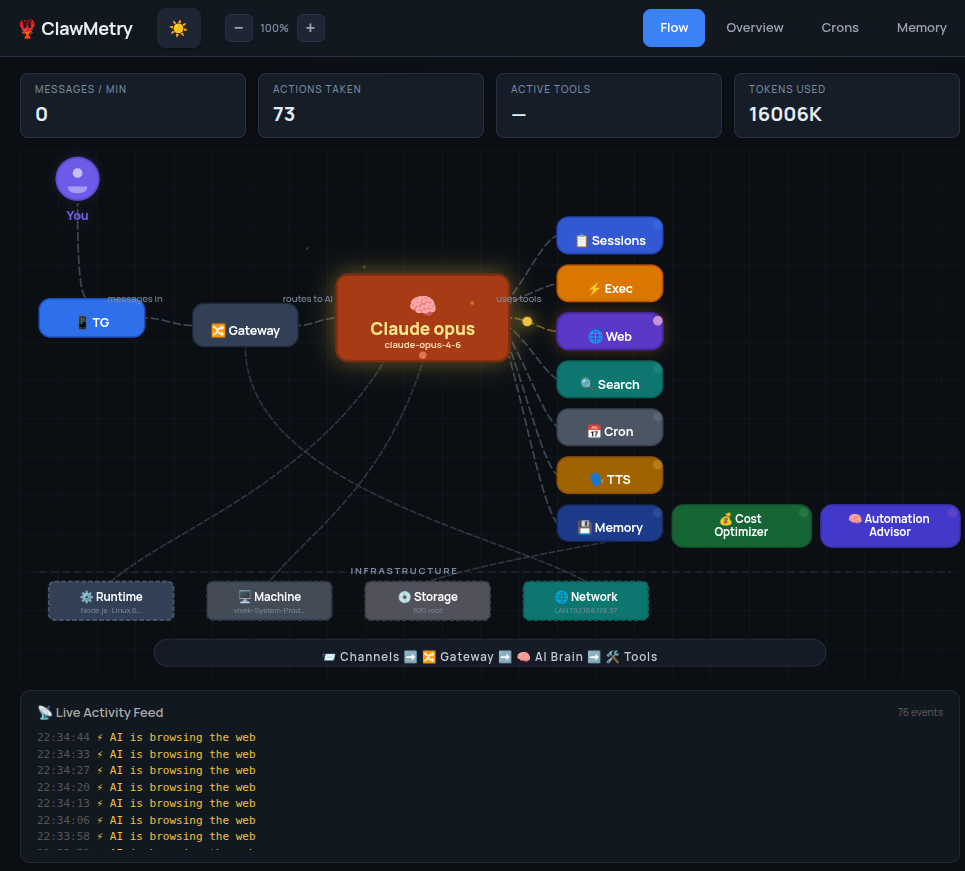
Guardalo in azione
Una sola schermata. Tutto ciò che accade tra i tuoi agenti.
I buchi sono nella tabella
Cosa possiamo fare, runtime per runtime.
Ogni fornitore in questa categoria parla di guardrail. Questa è la matrice completa, celle vuote incluse.
| Runtime | Osservare | Bloccare prima dell'esecuzione | Interrompere durante l'esecuzione | Costo in dollari |
|---|---|---|---|---|
| OpenClaw, NVIDIA NemoClaw, Goosefree forever | ✓ | via proxy | ✓ | ✓ |
| Claude Codethe only pre-execution tool gate | ✓ | ✓ | ✓ | ✓ |
| Codex, OpenCode, Aider | ✓ | via proxy | ✓ | ✓ |
| Cursorone IDE process holds every session | ✓ | – | – | – |
| GitHub Copilotbilled in vendor credits, not USD | ✓ | – | – | – |
| NanoClaw, PicoClaw, Kimi CLIno model id on disk | ✓ | – | – | – |
| Qwen, Hermes, Pi, Deep Agents, n8n, Antigravity, Grok, QM, DeepSeek Harness, Exo |
✓ | via proxy | – | ✓ |
Bloccare prima dell'esecuzione
Claude Code gets a real pre-execution gate: a PreToolUse hook parks the call before the tool fires. Everything routed through the ClawMetry proxy gets spend refused with a 429 before tokens are spent.
Interrompere durante l'esecuzione
A gateway kill for OpenClaw, and SIGSTOP then SIGKILL against the process tree for the CLI runtimes, with a guard so a recycled pid is never the one we hit. macOS and Linux. Windows has no SIGSTOP, so pause and resume do not exist there.
Verificare a posteriori
Every event carries a SHA-256 chain over its immutable fields, per node, with a verifier command. Approval decisions land in an append-only log. Works on every runtime.
Prima di mettere un daemon sul tuo laptop
Cosa fa alla macchina,
e cosa esce da lì.
Misurato su quello stesso laptop, non stimato.
Impronta
clawmetry uninstallThe query server binds to loopback only, with a one-time 32-hex token and a discovery file at mode 0600. It is why the dashboard can read the store without holding the writer lock.
Cosa esce, esattamente
Never. These stay in the local file.
The key is generated on the node and never leaves it. Decryption happens in your browser. Compelled by a subpoena, we hand over a blob we cannot open, plus the node id, the version and some counters.
Il file locale è in chiaro
Everything is sealed in transit and at rest in our cloud, and it is not encrypted on your own disk. The DuckDB file carries default user permissions. Anything running as your user can read it.
L'oscuramento può non applicarsi
Secrets are fingerprinted at ingest by default, before disk. It is pattern-based, and on an internal error it keeps the original value rather than dropping data. It is tuned for credential shapes, not customer PII.
Un nodo connesso può essere fermato da remoto
If you turn cloud on, Stop, Pause and Resume are reachable from the dashboard and the desk device for any node on the account. That is the feature. Run local-only and no such channel exists.
Starred by the people building AI
Engineers and founders from OpenAI, Google, PostHog and more have starred ClawMetry on GitHub. One of them helped build it.













Tre modi per eseguirlo
Il Cloud è opzionale.
Lo è sempre stato.
Il daemon elabora in un file DuckDB sul tuo disco. Dove vive la dashboard dopo, lo decidi tu, e la tariffa è la stessa qualunque cosa scegli.
01 · Local only
Non esce nulla
Included in the MIT core
The dashboard reads the local file through a loopback query server. There is no account, no sync and no destination to point at.
- Network destinations: none
- Inbound ports opened: 0
- Free forever for OpenClaw, NVIDIA NemoClaw and Goose
02 · Our cloud
Sigillato prima di uscire
$19 per node, per month
The snapshot is encrypted on the node with a key generated there and never sent. Your browser decrypts it. Subpoena us and we hand over a blob we cannot open.
- AES-256-GCM, key held on the node
- Decryption happens client side
- Stop, Pause and Resume reach any node on the account
03 · Self-hosted
La tua infrastruttura, single tenant
$190 per node, per year
One container serves the UI and the ingest API on your own network, with node tokens and admin auth. Licences verify offline against an embedded Ed25519 key you can fingerprint and compare.
- No calls to clawmetry.com beyond an off-by-default version ping
- Same feature set, same runtimes, same rate
- Two months free against the monthly price
La tariffa non cambia con il tipo di deployment. Self-hosted costa $19 per nodo al mese o $190 per nodo all'anno, esattamente come il piano Cloud, perché stai pagando il software e non i nostri server. Ciò che cambia è chi custodisce i dati e chi gestisce il container. Acquista una chiave self-hosted senza parlare con nessuno.
Una tariffa, un contatore
Calcola la tua cifra
prima di parlare con chiunque.
7 days, every runtime, no card
$19per node, per month
Pro, billed monthly. Starter is $9 and covers fewer features, not fewer runtimes. Annual is $190 per node, two months free. Free forever for OpenClaw, NVIDIA NemoClaw and Goose.
Start the trial- Every runtime, including Claude Code, Codex and Cursor.
- Cloud or fully self-hosted, at the same rate. Unlimited chat channels.
- Waste flags, error triage, cost optimizer, OTLP export, tool policy.
- Cancel any time in Stripe. No contract, no seat count.
Already decided? Buy now and install after. Your key is on the next screen.
Quanto ti costa
Conta le macchine che eseguiranno il daemon, non le persone che guarderanno i dati.
$551 $6,612 per year · 29 nodes
A node is a machine running the daemon and reporting a heartbeat. The unit of attribution is a machine, so spend maps to a laptop, not to a team. The same number applies self-hosted, so you can price a deployment on your own infrastructure off this figure without asking us. Ephemeral CI runners are not yet specified; the fleet brief carries the rule in writing before you sign.
Per chi si assume il rischio
Usarlo in tutta l'azienda.
I tuoi ingegneri hanno installato Claude Code, Cursor, Codex e Copilot lo scorso trimestre. Nessuno li ha acquistati ufficialmente, e tutti hanno accesso al tuo repo e alle tue chiavi.
Nessuna installazione dentro l'agente
Each runtime is read from the session store it already writes. No SDK, no wrapper, no second agent on the laptop, nothing a developer has to opt into or can forget.
A control layer that governs only its own SDK is blind to everything a developer runs outside it.Il self-hosting è la risposta all'SSO
SSO does not exist yet. Single-tenant self-hosted does: one container serves the UI and the ingest API, with node tokens and admin auth, and licences verify offline against an embedded Ed25519 key you can fingerprint and compare.
A self-hosted deployment makes no calls to clawmetry.com beyond an off-by-default version ping.Si adatta alla rete che hai già
SIEM and syslog export in CEF or JSON over TCP, UDP or TLS, emitted daemon-side because the cloud never holds plaintext. Corporate TLS interception is supported, with a doctor command that walks DNS, TCP, proxy and TLS in order.
In: your collector feeds us over OTLP. Out: full-event SIEM export. Not yet: correlated spans carrying your trace ids.Il rollout sulla fleet oggi è manuale
There is no Helm chart, no Terraform provider and no Intune or Jamf package. If a daemon on developer laptops is a non-starter, run the enforcement proxy centrally and govern spend without touching an endpoint.
Auto-update ships on by default. CLAWMETRY_AUTO_UPDATE=0 turns it off. No staged rollout, no version pinning.Le domande che riceviamo ogni volta.
Potete bloccare qualcosa prima che parta, o solo dirmi che è successo?
Both, and the split is in the table above. Claude Code gets a genuine pre-execution tool gate, and anything routed through the proxy gets spend refused with a 429 before tokens are spent. For the other runtimes it is detection plus process control: we can see it and end it, we cannot veto the call it already made.
Fermerà i miei agenti di sua iniziativa?
No. Detectors write a warning and stop there. On the reference install every flagged session ran to completion. A run ends only when a person ends it, or when you have set a spend cap yourself and an agent crosses it.
Cambia il modo in cui girano i miei agenti?
Read-only by default. Two things you opt into change that: the proxy, a separate process you point one env var at, and approval gates, where ClawMetry adds a gate to the runtime’s own permission system and removes only what it added.
Cosa succede quando finisce la prova?
The paid runtimes stop being read and the free three keep working. Entitlements are a commercial boundary, not a technical one. We do not hard-block a running fleet on a licence check.
Chi c'è dietro, e cosa succede se sparite?
One person, plus contributors. The core is MIT and runs on your machine, so if we vanish your install keeps working and your data stays in a DuckDB file you own. The paid layer is a separate closed package. Ask for the fleet brief and it names the legal entity, the largest deployment we run today, and the reference count, with no rounding.
Supererà una security review?
For a pilot on non-production machines, usually: MIT source you can audit, local-first storage, single-tenant self-hosted and offline licence verification are the arguments that work. For a regulated production rollout, read the gap list first. SSO, RBAC beyond owner and member, SOC 2, CAIQ and a third-party pen test are all absent, and that is a two-to-four quarter conversation.