 ClawMetry
Foundations
What is Physical AI observability? Follow a task from instruction to outcome
A clear introduction to the task, evidence, timing, and outcome questions behind robot observability.
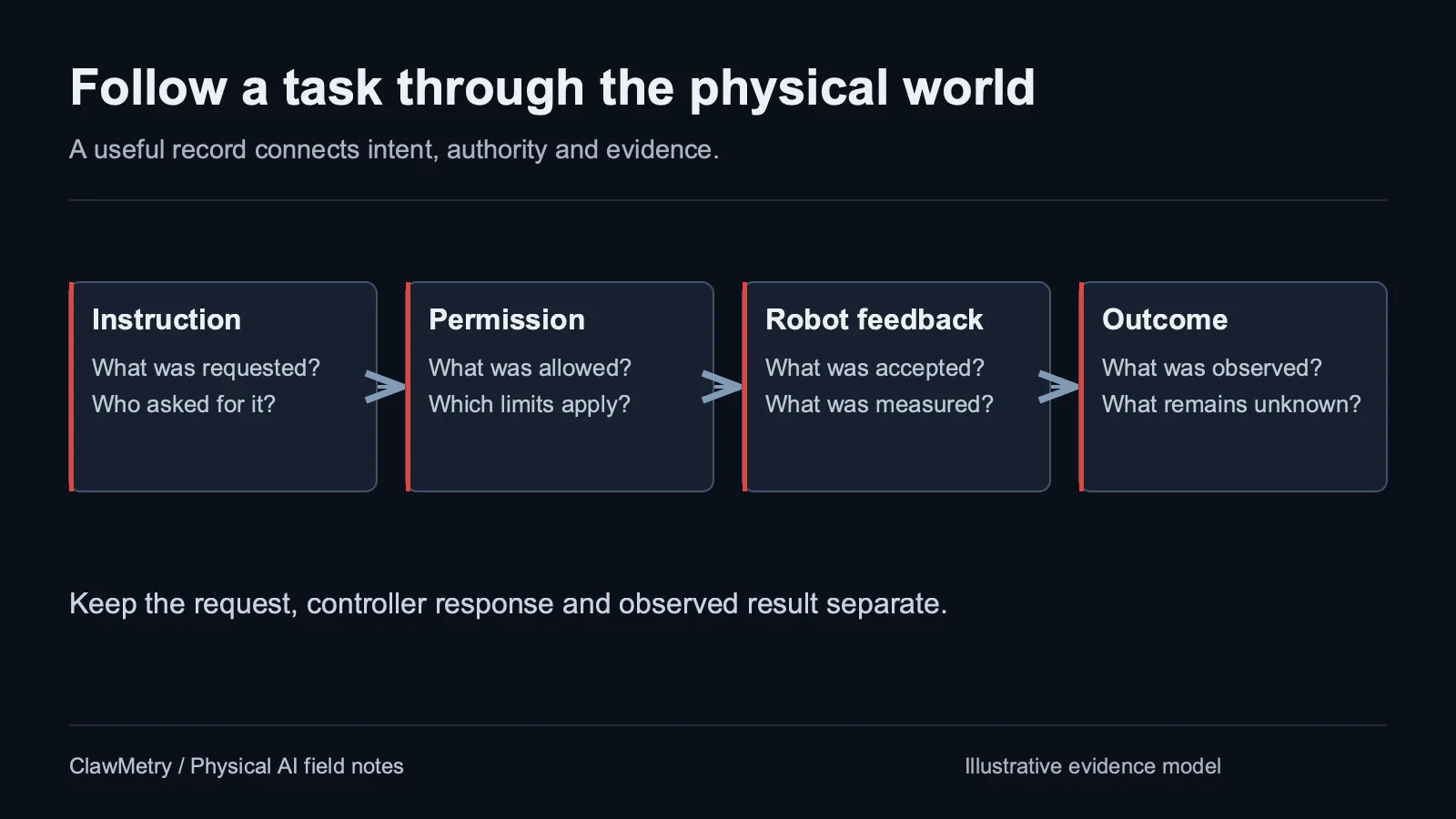
The question is what happened in the world
Physical AI observability collects and connects evidence about an AI-driven physical task. It helps a person understand the instruction, reported behavior, and outcome in the environment. The useful unit of review is the task. A single sensor chart or model transcript answers only part of that question.
Consider a request to put a pen on a plate. The instruction is accepted, the model proposes a movement, the controller processes a trajectory, and a camera shows the table. Each event can be real while the task still fails. Observability helps explain where the chain broke and which conclusion the available evidence supports.
Connect five parts of the task
Begin with the instruction and any subsequent change to it. Then connect the model's exposed requests or published notes to the controller interface. Keep acknowledgements separate from measured feedback. Finally, retain the scene evidence or operator review that supports the outcome.
An implementation can link those records through a task identifier while preserving their original sources and timestamps. OpenTelemetry's trace model is a useful reference for connecting related operations. It does not supply a complete robot-specific meaning for each event. The integration still has to define what its signals establish.
| Signal | What it tells you | What still needs evidence |
|---|---|---|
| Task accepted | The application received the request. | Whether the controller executed it. |
| Packet accepted | An interface admitted the packet. | Whether the arm reached its target. |
| Joint feedback | A source reported an arm state. | Whether the object reached its destination. |
| Camera frame | A scene from that camera at that time. | What happened outside the view or between frames. |
| Outcome review | A stated judgment against the task criteria. | Performance across other tasks or environments. |
Use plain language for the operator
The first screen should answer ordinary questions. Is a task running? What is it trying to do? Is the information fresh? Does someone need to take over? Expose identifiers and raw payloads when they help an investigation. A newcomer should not need to decode them to learn that a camera stopped updating.
A compact task summary can show requested, accepted, observed, and unresolved facts together. An unresolved field is useful information. Filling it with the last known value without its age creates confidence precisely where the observer should be asking for attention.
Separate the time an event happened from when you saw it
A robot, camera, model service, and browser may each report time differently. Preserve source time when available and observer receipt time as a separate field. If clock relationships are unknown, describe that limit instead of assuming a perfectly ordered history.
For review, inspect a short interval around an event and compare the signals that are actually available. An apparently late camera frame may reflect network transport rather than slow motion. An old joint reading may reflect a stopped collector. The timeline should support an investigation without deciding the cause in advance.
Observation and intervention have different responsibilities
Collecting a record does not by itself prevent an action. Enforcing a rule requires a supported gate before the relevant action, while a stop or handover requires a controller-specific operation and feedback about its result. A dashboard cannot turn a software acknowledgement into a safety-rated physical function.
This distinction keeps integration work manageable. Start by observing one real workflow. Once the record is reliable, evaluate what the controller can reject or interrupt and how it reports that response. Keep the local hardware procedures authoritative throughout.
Measure the observer too
A useful observer should report its own gaps, dropped records, source age, and storage limits. Decide how much camera history a task needs and how long it should be retained. Avoid capturing private workspace images merely because storage is available.
At ClawMetry, our SO-101 experiment and BluPe pilot provide concrete examples of these design problems. They are starting points with documented scope, rather than evidence that every robot platform is already supported. The practical test is whether a person can review a task afterward and distinguish a verified result from an unanswered question.
Sources and evidence
External sources support the attributed background. Integration accounts describe historical project evidence. Guidance and proposed tests are identified in the article.