 ClawMetry
Foundations
Robot guardrails: the difference between seeing, blocking, and stopping
A vocabulary for evaluating robot guardrails, with clear boundaries between observation and an actual control response.
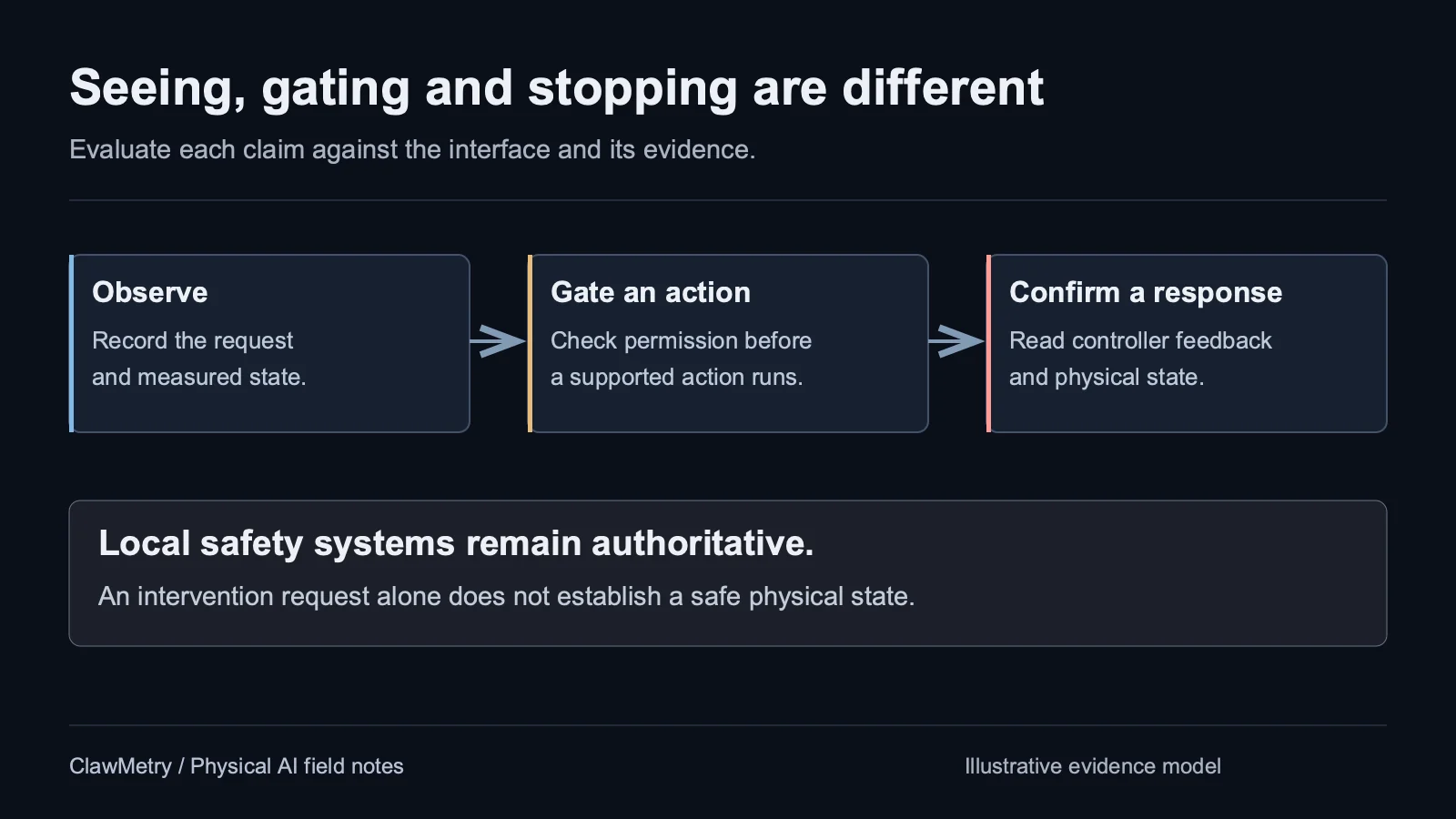
One word can hide several different promises
A team may say its robot has guardrails when it means the application displays an alert. Another team may use the same word for a check that rejects a task before it reaches the controller. A third may mean a local hardware safety function. These mechanisms have different evidence and responsibilities.
Before evaluating a robot integration, ask what the rule can actually do, where it acts, and how its result is observed. Use those answers to describe the feature. A rule name such as stay on the table is a starting point. The implementation must identify the measurements and supported interfaces that make it meaningful.
Observation records what the system can see
An observer can record an instruction, a request, a response, or a measured state. It may detect a condition after it happens. That information can support review or an operator alert, but it does not show that the action was blocked.
The distinction becomes especially important in public demos. A warning beside a camera feed can look like an active barrier. The interface should explain whether the rule is observing, rejecting a future request, or asking an operator to intervene. The alert's wording should match the mechanism's actual position in the system.
A pre-action check needs a gate
To reject an action before execution, a check must sit on a supported path before the relevant command is admitted. It needs an explicit failure behavior and a clear scope. A task-entry check may reject an instruction while saying nothing about later trajectories. A trajectory check may cover only the fields it receives.
Treat missing inputs carefully. If the check needs a fresh measurement and the measurement is absent, explain whether the request is refused or held for review. Avoid reporting a successful boundary check when the system lacked the information needed to evaluate it.
A stop request needs a measured account
Stopping is specific to the robot and its controller. A software response may acknowledge receipt without establishing that motion ceased. The observer should preserve the request, acknowledgement, subsequent feedback, and any interval where the result remains unknown.
Our SO-101 sessions included a case where continued wrist movement prevented confirmation of a requested hold. That historical example is valuable because it shows why uncertainty must remain visible. It is not a claim that ClawMetry provides a certified emergency stop or that the same behavior is available on every arm.
Natural-language rules need a reviewable meaning
A person should be able to express a boundary in familiar language. The software still has to translate it into something the available interface can evaluate. Show the interpretation before enabling it: the relevant object or region, the evidence used, the action covered, and the response when data is stale.
Keep the original instruction and the interpreted rule together in the record. If a person edits the boundary, preserve the version that applied to each run. Otherwise a later review may compare an old action against a rule that did not exist at the time.
Build a useful handover
A human handover needs an understandable status: what is happening, what has been requested, what response is known, and what the person should inspect locally. Afterward, keep the authorization to resume separate from the mere presence of a fresh camera frame.
For ClawMetry's Physical AI work, these are integration questions to validate with hardware owners. Existing software-agent controls and historical robot experiments do not establish universal robot control. A useful guardrail report names the exact gate or controller involved and tells the operator which conclusions remain outside its scope.
Sources and evidence
External sources support the attributed background. Integration accounts describe historical project evidence. Guidance and proposed tests are identified in the article.